|
An old saying suggests that those who have been in China for a
day, write a book; those who stayed for a month, write a
page, while those who stayed longer find it all too complex to
explain. Due to its complexity, no single book can provide the
definitive guide to China. The good news, however, is that some
'Old China Hands' have defied the conventional wisdom and wrote
about personal experiences and views.
In my view, China may
best be approached like the infamous five blind men approaching
the elephant - everyone explored a part and together they obtain
a reasonable image. Thus, I recommend to read around the topic -
read history and autobiographies, economic studies and novels,
especially by local authors. Here are a few books that I have enjoyed
over the years:
|
|
Contemporary Society
Good
books on contemporary China are scarce because it
rather difficult to write a balanced analysis of today's Chinese
society without being out of date very quickly. There
are a number of journalistic books that selectively report
negative aspects, but that miss the bigger picture; I don't
recommend that sort of book. There are also propaganda pieces
that I don't value much either. Hence, the selection that I have
here is short and starts with a book that starts with a
lot of history.
|
 On
China, by Henry
A. Kissinger, published by Allen Lane, 2011 (Paperback, Penguin,
2012). On
China, by Henry
A. Kissinger, published by Allen Lane, 2011 (Paperback, Penguin,
2012).
Henry Kissinger is both a highly acclaimed
political scientist, and a pivotal player in
U.S.-Chinese diplomatic relations in the 1970s. His combination
of deep scholarly knowledge and practical experience in
diplomacy are integrated in this volume, probably one of the best
contemporary books explaining Chinese history and politics to
Western audiences.
About one third of the book is dedicated to
explaining how Chinese, especially Chinese leaders, see their
own history and hence the role of China in the global society.
Historically, China saw itself at the centre of the world, and
as the most advanced economy: At its peak in the late 18th
century it probably accounted for more than a quarter for worldwide GDP.
From this perspective, the relative decline of the 19th and 20th century
is an anomaly; hence most Chinese leaders over recent decades
see their rightful place on par with the big powers. Kissinger
artfully outlines Chinese history from this perspective,
skillfully outlining the broad lines without getting stuck on
details.
From 1970, Kissinger was deeply involved in
establishing diplomatic ties between the U.S. and China,
including a secret visit in 1971 preparing president Nixon's
historic visit in 1972. In this book, he recounts his
conversations and the diplomatic thinking of the Nixon
administration that led to those historical events, and a tacit
(though never formalized) alliance between socialist China and
capitalist America against their common foe, the Soviet Union.
For the latter parts of the book, Kissinger interprets world
politics since that time to the present day in light of both
Chinese history and the events of the 1970s.
Kissinger's
account of the cold war period highlights the strategic
diplomacy of the superpowers aiming to prevent any one of the
three (Soviet Union, China, U.S.A.) to assume hegemony beyond
their region, or to 'encircle' the other. Yet, they paid
negligible attention to the national interests (or human rights)
of smaller nations. Treated like pawns in someone else's game,
they obviously weren't happy - and more than once 'when elephants
dance grass got trampled', in this case especially in Korea and Vietnam. Unfortunately, Kissinger does not nearly display
as deep understanding of Vietnamese and Korean history than of Chinese history.
|
 The Party: The Secret World of China's Communist Rulers , by
Richard McGregor, published by Allen Lane, 2010 (Penguin
Paperback, 2011). The Party: The Secret World of China's Communist Rulers , by
Richard McGregor, published by Allen Lane, 2010 (Penguin
Paperback, 2011).
How China is really ruled is a puzzle for most
Western observers, even for many Chinese
themselves. The party appears to be everywhere, yet at the
same time it does not have the same degree of micro-control that authoritarian regimes elsewhere in the
world may have. After several years as
Financial Times
correspondent in China, Richard McGregor put together his
insights on the party in a lively and very insightful book.
Extracting key insights from the book however
is difficult, for two reasons. First, the interfaces of the
party with virtually every major organization in China are
complex and hard to capture in a few sentences. Second,
McGregor's writing style is not very helpful in that he is
meandering, jumping from one anecdote (experience, news item,
personal interview) to another and back again, emphasizing the
every present nature of the party - but not presenting what
evidence he has systematically, or explaining the logic of how
it works. By journalists' standards he does reasonably well (you
probably expect me to call for more systematic
presentation of facts and more systematic analysis, given that I
am an academic). However, the subject itself deliberately
obscures itself such that such systematic evidence is hard to
come by (for a good attempt see
Brodsgaard,
China Quarterly, 2012). Yet, there are a few
journalistic generalizations, even polemics, which make it too
easy for those aligned with the party to dismiss the book as
poorly researched propaganda.
Reading this book however does help a lot to
explain contemporary politics in China, such as the rise and
fall of Bo Xilai as governor of Chongching, and the succession
of Xi Jinping to the leadership of the party. One function of
the party resembles an HR department of a large company: it
follows all cadres careers, and makes sure that those that
actually taking leadership positions have worked in a variety of
different functions and provinces before - all the seven new
leaders in 2012 have before been leading economies (i.e. cities
or provinces) of the size of a major US state or European
country.
Understanding the role of the party also
greatly helps explaining why it is an uphill struggle to contain
corruption, even though it is prioritized by the new leadership
in 2012. Essentially, Chinese provinces enjoy a lot of autonomy,
even tough their leaders are rotated around the country, and
power is highly concentrated - the government, police heads,
judges and even journalists are in one way or another dependent
one the same party leaders. Hence, China does not have what in
the West since the French revolution is called the 'separation
of powers'. This makes it very difficult to launch an
independent investigation into any government mis-behavior (e.g.
shady land deals), and corrupt officials tend to 'fall' only
when they either fall out of favor politically (like Bo Xilai),
or when they overdo the corruption and the display of wealth.
There is much more to this book that this
small review can't capture. It is a worthwhile, perhaps even
required, reading for those engaging with China, though not an
easily digestible read.
|
 Across
the Great Divide: The Sent-Down Youth Movement in Mao's China,
1968-1980, by Emily Honig and
Xiaojian Zhao, published by Cambrdige University Press, 2019. Across
the Great Divide: The Sent-Down Youth Movement in Mao's China,
1968-1980, by Emily Honig and
Xiaojian Zhao, published by Cambrdige University Press, 2019.
The 'sent-down youth' movement was one of the socially
disruptive policies of communist China. School graduates from
the urban centres along the coast were resettled to the country
side. There supposed objectives were to combat youth
unemployment, in the cities, "reducate" the poiled urban youth,
and to help economic development in the Western provinces.
However, both senders and receivers were ill prepared for the
supposed contribution they were to make. Instead, the movement
pulled families apart and created extensive suffering among the
young people unfortunately enough to complete their school years
in the early 1970s. There are indeed often refered to as the
lost generation - in that age group, China lack
university-educated people.
Honig and Zhao have traweled
through documents in both sending cities and receiving
communities, and interviewed eye witnesses to provide new
insights on how the movement unfolded. The mobilization of the
'youth' in teh city was predictable difficult, and certainly not
voluntary. At later stages, the better connected the family, the
less likely youth would be sent, and the better their chances of
early return. Many receiving communities initially struggled to
find meaningful work for the youth, and to feed them.
Intergration rarely happened. However, Hong and Zhao also
identify some cases of economic benefits through informal ties
created by the youth; thus city governments would send supplies
and even machines to the communities where their youth lived,
and and thereby indirectly helped their development. Ultimately,
the movement however failed in achieving its overarching aim of
reducing the economic and social divide between urban and rural
China.
The account by Honig and Zhao is vivid in its
stories, and compelling in the breadth of the evidence. It makes
for uncomfortable reading of a depressing episode in recent
Chinese history; an episode that is rarely openly discussed in
China itself.
|
 Facing
the Era of Great Transformation: Essays on Deepening Reforms,
by JInglian Wu, published in English in 2021 by
Palgrave Macmillan. Facing
the Era of Great Transformation: Essays on Deepening Reforms,
by JInglian Wu, published in English in 2021 by
Palgrave Macmillan.
The continuous debates within China
that underpin its remarkable transformation over the past half
century are often hard to appreciate for outsiders. The path of
reform policies has been shaped by internal debates between
influential groups within the political elite (see
Cheek et al., 2021).
Jianglin Wu of
CEIBS has been an active participant in these debates.
This book brings together essays and speeched that Professor Wu,
a highly respected senior economist in China,
has given between 2007 and 2013. His essays describe the reform
processes - and associated debates - over the past decades, and
offer informed opinions on this recent history. Throughout his
various contributions, he emphasizes the importance of continued
opening and market reform, emphasizing the role of private
entrepreneurs in China's economy growth, and the importance of
market processes in enabling such entrepreneurs. He comments
various specific concerns arising over time, and offer
constructive suggestions to adress these within the existing
political institutional context of China. A theme that runs
through his essays, especially those written after the outbreak
of the global financial crisis (which had comparatively little
effect on China) is the concern of a reemergece of state actors
directly interfering in businesses, rather than focusing on
emhanced regulation of market activity.
Reading these
essays in 2021 - they were originally published in Chinese in
2014 - highlights recent changes in two ways. First, the
trajectory of institutional change has significantly changed
direction since 2014; the balance between state and market as
well as between openness and self-sufficiency have shifted
significantly. These debates, by the way, have been oscilating
in China for centuries, not just in the current era. Second, the
style of debate within China also has significantly changed.
|
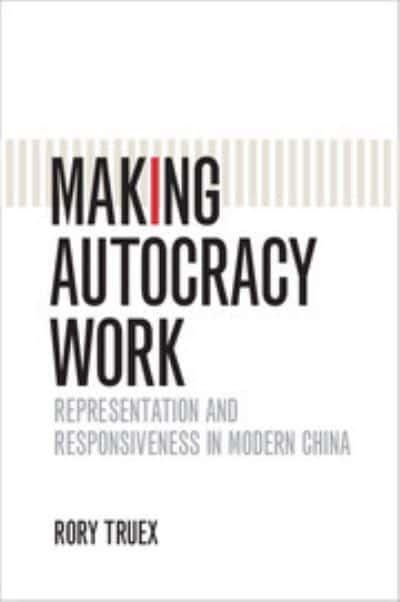 Making
Autocracy Work: representation and Responsiveness in Modern
China, by Rory Truex, published in 2016
by Cambridge University Press. Making
Autocracy Work: representation and Responsiveness in Modern
China, by Rory Truex, published in 2016
by Cambridge University Press.
How can a political system by authoritarian,
yet stable? For decades Western observers have predicted the
demise of Chinese political regime because of it
non-democratic nature and the changing needs of an increasingly
affluent urban society. This study offers an answer to the
puzzle by explaining the role of the National People's Congress
(NPC).
Rory Truex,
an
Assistant Professor at Princeton, argues that China's system
of "representation within bounds" is based on four principles:
1) representatives, i.e. NPC members, are encouraged to convey
opinions of the people of their constituency to the leaders, but
only on 'low preference issues'. The critical condition here is
'low preference issue' which means issues that are not central
to the views of the autocrat - say, the need for better water
irrigation, a new school building, or resolution of an
environmental issue locally. 2) representatives face penalties
if the challenge 'high preference issues', which in the Chinese
context refer to the legitimacy of the rule of the party, the
legitimacy of individual leaders, and any issues remotely
related to the boundaries of China. 3) representatives are
incentivized to show 'selective empathy' with their
constituents, i.e. effectively representing their interests on
low preference issues, while representing the party line when it
comes to high preference issues. 4) Representatives will be
rewarded for their loyalty, for example by re-appointment or
through indirect benefits arising from the networks created as a
NPC member.
Truex offers a very comprehensive and thorough
analysis of his propositions, first by explaining the incentives
of all key actors in a game-theoretical model, and then by a
series of specific empirical studies that test some of the
predictions of his theory. Data on the activities of NPC members
are limited, but he still has been able to find an impressive
amount of details which allow his to rigorously test the
propositions. For business scholars perhaps most interesting is
the monetary benefit of NPC membership: he finds that firms
gaining representation in the NPC in 2008 increased returns by
1.5% and operating margins by 3 to 4% while share prices were on
average more than 10% higher than comparable benchmark firms.
Overall, based on my own numerous
communications with lots of people in China, the findings and
the theoretical argument explaining them is highly credible.
Hence, if you worry how stable China is politically, read this
book.
|
 Trouble in the Middle: American Chinese
Business Relations: Culture, Conflict, and Ethics,
by Steven P. Feldman, published in
2013 by Routledge. Trouble in the Middle: American Chinese
Business Relations: Culture, Conflict, and Ethics,
by Steven P. Feldman, published in
2013 by Routledge.
Steven Feldman set out to study Chinese-American
business relationship through
interviews in both business communities, and presents a
profoundly insightful description and analysis not only how both
business communities operate, but how they think about each
other, and how they manage to do businesses despite deep gulfs
between their practices and value systems. His central thesis is
that the middlemen, who are so often managing the interfaces
between American and Chinese sides in a business, face most of
the moral dilemmas, while American business persons pretend to
know anything of practices that would be unethical or illegal in
the USA.
Feldman focuses on the ethics of practices in
use. He starts from the recognition that ethical standards
are part of culture, and therefore not universal. Individuals
from different cultures, and hence ethical value systems, thus
necessarily encounter situations where their value systems do
not match. He thus observes that in this situation step
"middlemen, who specialize in developing relationships with both
cultures so as to bridge the relationship between them. But from
an ethical point of view, the situation does not develop
community, ... the middleman keeps the two business cultures
apart. Since the ethical context for each culture is different,
keeping the sides apart keeps the seeds of a new moral community
from developing, ... it keeps the parties wary and distrustful."
(page 37).
Using his interviews as a starting point, Feldman
explores and analyses both Chinese business culture and the
perceptions and actions of US businessmen in China by setting
them in broader sociological and historical perspectives. This
leads him to explain the extensive use of personal
relationships (the book cover features the characters for guanxi
关系), and of
bribes, as an outcome of not only cultural values but of power
relationships (including those in the political sphere), and of
legacies of an unprocessed recent history. Overall, thus, he
ends up being very critical of US businessmen compromising their
values (while formally complying with the US foreign corrupt
practice act), and pessimistic regarding the evolution of
a moral common ground that would allow US-Chinese business
relationship to prosper based on a common understanding of what
is and what is not permissible.
|
|
Business:
I am not a great fan of 'Doing Business In' books, yet the
following books provide rounded insights into business in China
that is informed by both first-hand experiences and a broader
vision of the Chinese context.
|
 Pioneers,
Hidden Champions, Change Makers and Undersogs,
by Mark J. Greeven, George S. Yip, and Wei
Wei, published by MIT Press, 2019. Pioneers,
Hidden Champions, Change Makers and Undersogs,
by Mark J. Greeven, George S. Yip, and Wei
Wei, published by MIT Press, 2019.
Over the past 30 years, China has
become an entrepreneurial powerhouse. Depite the persistent
presence of large and historially state-owned firms, the
economic transformation of China has to a significant degree
been driven by entrepreneurs.
In this book, three business
professor and consultants document 35 Chinese entreprenurial
firms that have driving domestic innovation in China. They
reflect a wide variety of experiences across generations,
personalitsies, industries and approaches to innovation. These
entrepreneeurs are either market leaders in China in tehir
industry using technologies and/or business models that are
ditinctly different from those in "advanced" Wetsern economy (in
some case, notably in the digitla economy, even ahead of North
America or Europe), or they have espetblished themselves
globally as leaders in particular niche industries. They each
have developed thier own approach to innovation, but research
and technology is at the core of what they do. However, they
also reflect a huge diversity: The main lesson I took from the
book is that there is not one Chinese approach to
entreporeneurship, but many diverse approaches.
The ecosystem of entrepreneurial
firms documented in this book provides a foundation not only for
China's economic prosperity and global competitiveness, but for
China's ability to respond to the coronavirus respone (the book
was published before the crisis). If we want to understand the
miracle of the recent unprecedented economic growth in China,
and its ability to handle a variety of different economic
shocks, we need to look beyond teh role of industrial policy and
other government interventions (which are mentined but not
analyzed in depth in this book), to understand how individual
entrepreneurs have been taken advantage of innovation
opportunities and thereby transfered Chinese society.
|

China Entrepreneur: Voices of Experience
from 40 International Business Pioneers,
by Juan Antonio Fernandez and Laurie Underwood, published by
Wiley, 2009.
This book systematically reviews all aspects
of doing business in China for foreign businesses, while
providing hands on experience and anecdotes and short case
studies. The authors are a professor and a journalist, and the
book brings out the best of both professions by being both
systematic and accessible. Empirically, the book is grounded in
fairly detailed interviews with 40 entrepreneurs.
The focus is on an unusual sort of
international business, individuals who set up their own
entrepreneurial business in China. They thus operate like a
Chinese entrepreneur, yet coming from the outside with all the
advantages (e.g. international linkages) and disadvantages (e.g.
lack of local guanxi) that come with it. While challenging, it
is possible, as all these entrepreneurs have a track record of
survival.
The hands-on character of the book is at its
best when tackling sensitive issues, where generalizations are
difficult. Fernandez and Underwood let their interviewees do the
talking, relaying very rich experiences that they had in dealing
with local business partners, employees, and authorities. There
overall message is one of optimism "it can be done - if you know
what fallacies to avoid". For example in the chapter on "Ethics
and Corruption", they tell stories of individuals who have been
(or felt) cheated at some stage, but have learned their lessons,
and prevailed. The authors draw their own suggested lessons, but
the best preparation for a diverse and unpredictable environment
may be to know a lot of stories to be recalled when facing a
difficult situation.
|
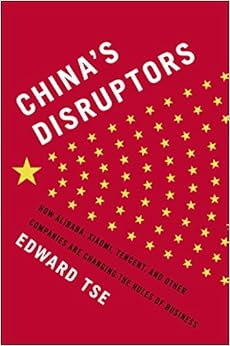 China's
Disruptors, by Edward Tse,
published by Penguin, 2015. China's
Disruptors, by Edward Tse,
published by Penguin, 2015.
By 2015, entrepreneurship in China is
gathering pace, and several books are trying to clear up the
myth that business in China is all about copying ideas from
elsewhere. Edward Tse, a seasoned China-based consultant,
provides a comprehensive argument supported by a wide range of
hands-on examples such as Alibaba, Tencent and Xiaomi (new books
in 2015 with similar objectives are
Alibaba's World by
Porter Erisman, and The End of Copycat China by Shaun
Rein).
Entrepreneurs have become drivers of change in
many industries, and thus of society, in China. Edward Tse
emphasized their entrepreneurial spirit, and their evolving
business models over the past three decade - along with
institutional change in the country. He attacks in particular
the assumption in American media and talk shows that Chinese
businesses are all about copying. To the contrary, he argues,
Chinese entrepreneurs are engaged in very fast paced innovation
processes. Their innovations are however primary in business
models and processes rather than in technology per se, and
perhaps for that reason not so evident from a distant. Yet,
competition is intense in China, and only those who continuously
come up with new product variations can stay ahead.
Tse is taking an uncompromisingly optimistic
view of both the power of entrepreneurship and of the evolution
of Chinese economy and its regulatory environment in the future.
No space for critical reflections here. I guess consultants are
like that. This is refreshing in its contrast to other books I
find on American airport bookshops. Yet, in my own view, Tse
underrates the tensions and risks faced by Chinese
entrepreneurs, not only due to volatility of the economy, but
also because the path of regulatory reform is in many sectors
hard to predict - it is often two steps forward, one step back -
or even three steps back (say, on internet regulation). The two
steps forward are important, but only part of the story.
Entrepreneurs in China face a tenuous relationship with the
authorities that to manage is an important skill required to
succeed in China. Tse cites Wang Jianlin, CEO of the real estate
group Dalien Wanda, advising "be close to government, but far
from politics"; a very insightful comment indeed.
|

KFC in China:
Secret Recipe for Success, by Warren K
Liu, published by Wiley in 2008.
KFC is one of the biggest success stories of
foreign investors conquering Chinese consumers, exploiting the
appeal of American fast food, yet becoming more Chinese than
most - what they call 'An American brand with Chinese
characteristics. Globally KFC may be trailing McDonald, but in
China KFC is undisputed #1 in this segment. Warren Liu was part
of this success story for a few years in the late 1990s, and now
tells the story partly as insider who recalls how it happened,
and partly as outsider with the distance that allows for
critical reflection. The book is still written with the positive
spin that business people like to give to their stories, not the
critical analysis an academic might deploy, but even so it
provides many insights as to what works and what does not work
in China.
The 'secret recipe' had been to find
innovative ways of being both global and local at the same time.
KFC was one of the first to enter China, and it made this
pioneering spirit the core of its philosophy driving to ever
more cities and towns across China. Perhaps most critical at an
early stage was to bring together people with both fast-food and
China expertise - mostly from Taiwan - to build operations that
fit China with its idiosyncratic and rapidly changing consumers
and government relationships. Emphasizing the development of
people, and empowering them to develop solutions that fit the
local context allowed KFC to grow faster, build a brand highly
valued by Chinese consumers, and be more profitable than KFC
elsewhere in the world. This book provides a very accessible
account of how they achieved it, while providing insights of
what happens 'behind the stage' of a fast food restaurant chain.
|
 400 Million Customers,
by Carl
Crow, published in 1937;
republished by Earnshaw Books in 2008. 400 Million Customers,
by Carl
Crow, published in 1937;
republished by Earnshaw Books in 2008.
Business seems always changing, yet some
things remain the same, or even come back after they lay
dormant for generation. This book, written by an 'old China
hand' in 1937, provides a glimpse of Chinese business and
culture through the eyes of an advertising agent, who worked (and
made lot of money) in Shanghai of the 1920s and 1930s,
introducing Western goods to Chinese consumers. Advertising
agents observe potential consumers much like an anthropologist
would, though with more mercurial objectives. Educated as a journalist, Carl Crow
writes about his experience in a lively way, providing wonderful
insights in the Shanghai of the 1930s.
Naturally this leads to reflections over the
continuity and discontinuity of culture - and business culture
in particular. In some ways Shanghai 2010 is more like Shanghai
1930 than Shanghai 1970. Yet, in other ways, Shanghai seems to
have changed for good - for example the constant haggling over
price is still a popular past time, but taxis and shopping mall
work with fixed prices. But many Shanghai women today may still
fit this description (p.19): they "discovered many
centuries ago that, if they would make themselves attractive
enough, their husbands would willingly employ servants to do the
cooking and scrubbing" [which was the job of the typical
American housewife of the time].
More on business, and of great concern to
contemporary business is the observation (p.80): "Because he is
always an individualist it is not easy for a Chinese tO fit
comfortably into a big business organization. He feels at home
in a small one, for that is more or less a family affair...". I
believe Crow is right to characterize Chinese as individualistic
with strong loyalty to family and other relationships - very
much in contrast to the assertion by management guru Geert
Hofstede who categorized them as collectivists.
As a bonus, Crow offers in chapter 18 and
succinct comparison of British and American export managers
("John Bull and Uncle Sam") flogging their produce in Shanghai.
|
|
 China's Management Revolution: Spirit, Land,
Energy, by
Charles-Edouard Bouée,
published by Palgrave, 2011. China's Management Revolution: Spirit, Land,
Energy, by
Charles-Edouard Bouée,
published by Palgrave, 2011.
This book advances the central hypothesis that
China economic advance experienced a fundamental shift in the
year 2008. From 1978 to 2008, the author argues, China has
essentially tried to emulate the American model of capitalism,
see it as a means to overcome its own economic backwardness.
Yet, in 2008n three events happened that changed the way Chinese
people - and their government in particular - view the world and
themselves. Firstly, the Sichuan earthquake which was handled by
the authorities in a relatively mature manner, second, the
Olympic Games in Beijing which demonstrated to Chinese people
themselves their coming off age, and, third, the world financial
crisis which undermined the role model function of
Anglo-American capitalism. In consequence, China has become less
likely to adopt lessons from the USA (let alone listen to them),
and more focused on developing its indigenous approaches to
developing its economy. This is a very important hypothesis,
and, if correct, the consequences for the world economy are both
profound and hard to foresee.
The hypothesis is outlined in chapter 2. The
rest of the book, however, while generally knowledgeable about
China, did not tell me many new insights. The author does not
discuss the consequences of his important hypothesis. Moreover,
I got very irritated by his US-centric way of interpreting
China. For example, he calls the 1978-2008 period "The American
Experiment", and constantly refers to the US as the only
relevant version of capitalism (except for a brief remark in the
penultimate chapter on page 162). In my understanding, the
Chinese authorities have always been highly selective when it
came to adopting imported ideas, and they have been looking at
the experience of more than one other country. While such
US-centric may be sadly common among Harvard MBA graduates of
that generation, I kept wondering how a leader in world-famous
consultancy with responsibility for France, Belgium and North
Africa - and a French name - can fail to realize that there is
more than one version of capitalism in this world?
|
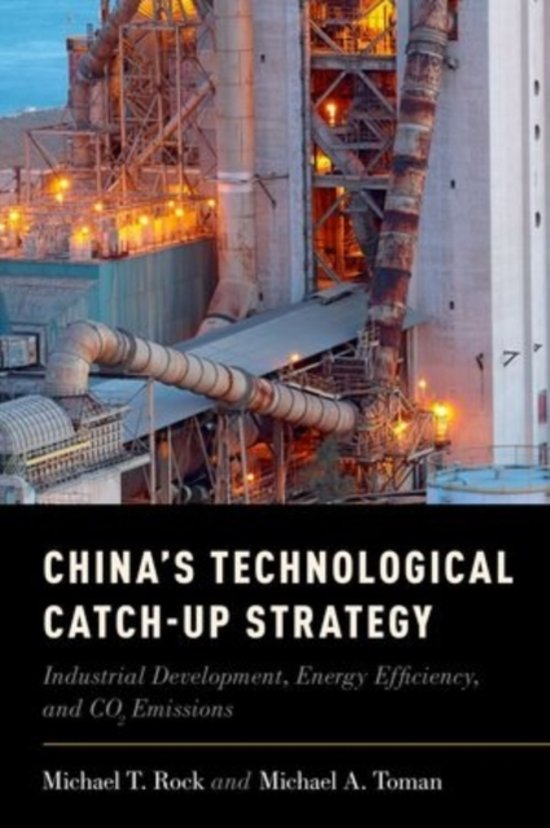 China's
Technological Catch-Up Strategy, by Michael T.
Rock and Michael A. Toman, published by
Oxford University Press, 2015. China's
Technological Catch-Up Strategy, by Michael T.
Rock and Michael A. Toman, published by
Oxford University Press, 2015.
This has over the past three decades invested
heavily in reducing its energy use and its carbon emissions.
This has resulted in major reductions of the energy and carbon
intensity of the Chinese economy. While industrialization and
economic growth have resulted in China becoming the largest
emitter of carbon, these emissions are about one
third of
what they would have been without technological catch-up in a 'business
as usual' scenario (Figure 10.1 of the book).
This scholarly study investigates the question
how China has achieved this carbon reduction, focusing on four
industries: cement, steel, aluminum and paper. At the outset in
the 1980s, China has an unusually fragmented industry with may
sub-optimal sized operations, a result of the peculiar
industrialization policy of the 1960s and 1970s. Closing many of
the small plants thus contributed to enhancing efficiency and
reducing emissions. Beyond that, firms have invested in
technological upgrading not only by importing latest technology,
but by developing human capital to optimize such machinery under
Chinese conditions. The authors emphasize that firms acted under
a policy regime that shaped incentives firstly by ensuring that
prices for energy closely resemble their true costs (in contrast
to other emerging economies where energy is often subsidized),
and secondly through specific interventions such as energy
consumptions targets and investment in R&D.
The book presents a lot of evidence to support
these basic insights, which unfortunately makes it rather boring
to read. Most readers will find the essence of the arguments and
findings in Chapter 3. The firm level case studies within the
next chapters also insightful: Luzhong Cement Factory (p.
51-56), Baosteel (p. 88-93), and Yueyang paper company (p.
160-166). Moreover, Chapter 9 provides an illuminating
comparison with Indonesia that shows how important it is that
industry insiders do not 'capture' policy makers, but
competition between firms and local government - despite all the
imperfections of bureaucracy in China - is key to driving this
progress.
|

Silicon Dragon: How China is Winning the Tech
Race, by Rebecca Fannin, published by McGrawHill, 2008.
Journalist
Rebecca Fannin
has interviewed IT entrepreneurs in China, and talked to their
business partners and industry insiders, to tell the story of 12
remarkable individuals striving to build a new business. The
experiences have a lot in common with IT entrepreneurship
elsewhere, for instance in Silicon Valley: inventive engineers
with ambitious ideas and big money slashing around - yet whether
the business models will eventually generate rich returns for
the entrepreneurs, or yet another technology changes the path of
history, is often hard to predict.
This book has little to say about
China-specific issues, which is also its main message: China is
rapidly converging with the West, both technologically and in
terms of how capitalism works. Fannin asked her interviewees
about issues such as the tenuous relationship between businesses
and the party, and censorship, but her respondents suggest that
it is a non-issue: tech savvy internet surfers appear to know
how to get around the 'firewall' (are you sure?). However, in
passing she makes another important observation: Chinese
entrepreneurs in their 30s and 40s lack role models at home, but
are rapidly becoming role models for the next generation of wizz
kids.
With the rapid evolution of e-commerce in
China, the book is already becoming historical. The Internet in
China is developing rapidly but not following the same paths
laid out by Californian entrepreneurs a decade ago. Hence,
Chinese entrepreneurs now advance distinct business models that
provide local firms an advantage, see for an early account The
Economist, 2010,
An Internet
with Chinese Characteristics, July 30.
|
|
(Auto-)Biographies: Western Perspectives
Personal experiences
are often the richest and most practical avenue to build an
understanding, provided they are written with a healthy degree
of humility and self-reflection. China is changing so rapidly
that some may dismiss the relevance of past decades. Yet, the
past informs peoples' views of the world, and their perception
of the presence. Older autobiographic stories thus complement
recent ones.
|

The Man who Loved China: The Fantastic
Story of the Eccentric Scientist who Unlocked the Mysteries of
the Middle Kingdom, by Simon Winchester,
published by HarperCollins, New York. 2008.
In
1937, Joseph Needham fell in love with with a Chinese women,
then with the Chinese language and eventually with China itself.
He was a distinguished scholar in Cambridge, who even at young
age had distinguished himself in the field of embryology. Yet,
an encounter with a Chinese colleague changed the path of his
scholarly endeavors, and in 1943 he found himself in Chongching
in the most unlikely circumstances. The Japanese had occupied
most of China, Chongching was the capital of the nationalist
government of Chiang Kai-chek, and life was hard for everyone in
free China as well as in the occupied territories.
In these circumstances, Needham's scientific
ambitions led him on a scholarly travel adventure to some remote
corners of the country. His ambition was to prove to the world
that for centuries, China had been creating many scientific
inventions well before Europeans, let alone Americans. He
collected records from historical sources and from Chinese
scholars, that became the basis for his epic 24-volume work "Science
and Civilisation in China" (Cambridge University Press,
1954-2004). Simon Winchester tells the story of this remarkable
man, and through his eyes reports life in China in the middle
of the 20th century, and in centuries before. The book is
immensely readable and makes the reader think - not just about
China's past and future, but about the sometimes surprising
pathways of scientific inquiry.
|
|

Go Gently through Peking, by
Lois Fisher, first
published by Souvenir Press, London, 1979. (In the US, it was
published as "A Peking Diary" 1980; I read the German
translation "Alltag in Peking" published by Fischer TB)
In 1973, few foreigners were allowed into China. As one of
the first Western journalists, Gerd Ruge reported for German television from Beijing
during Mao's final years. His American wife, Lois Fisher, joined
him and had to organize their lives under tight official
restrictions and poor general living conditions. Her
autobiographic report tells of the joys and frustrations of live
in Beijing - from finding a flat to live, to shopping where
Westerners had not ventured before. She makes friends with
Chinese people and provides insights in their lives that
official reports - even journalists - can rarely capture.
Her
story culminates in the events surrounding Mao's funeral, and
the dawn of a new time. Reading this autobiography three decades
later, one can only be amazed of the transformation that Beijing
has gone through since that time - not only in high profile business and
politics, but in
everyday lives. For example, bicycles have been replaced but cars -
creating traffic jams unimaginable in 1973.
|
|

China nach dem Sturm
(China after the Storm), by Klaus Mehnert, published by
DVA Stuttgart, 1971; Published in English by Dutton as "China
Returns", 1972.
"Until recently, China was almost as unknown as the moon", Klaus
Mehnert writes in his introduction in 1971. Hard to imagine today,
China was entirely closed to foreigners during the Cultural
Revolution, and Mehnert was one of the first foreigner to
receive a visa and the permission to travel across the country.
Yet, this was not his first visit to China; he had visited it
several times from 1929 to 1957, and spend World War II as
university teacher in Shanghai. He was an established scholar of
the socialist countries when he took off for a month-long visit
in 1971.
The account of his journey provides a unique immediacy
of experiences, observations and conversations with people with
and without power. They are set in the context of the evolution
of the socialist regime under Mao Tse-Tung (who was still alive),
including the Great Leap Forward, the centrally coordinated
push for industrialization, and the Cultural Revolution.
|
 Mr
China: A Memoir, by Tim Clissold,
published by Harper, 2004. Mr
China: A Memoir, by Tim Clissold,
published by Harper, 2004.
Tim Clissold was involved in some of the first
foreign investments in China in the mid 1990s: When China opened
up for financial investors, he toured the country in search of
investable firms, and set up joint ventures. He recalls his
experience of the years 1993 to 1999 in a most vivid way,
telling of companies and people that went through the most
remarkable transformations. As a foreign investors with an
office in Beijing yet not on the ground in the provincial towns
of his investments, he experienced many dramas of fights over
control of the businesses that his company thought they owned,
only to find their investments disappearing like quicksand.
It is hard to draw lessons from this, and even
harder to assert whether these lessons still hold true today, 15
years later. But the messages that I drew from his various
investment case studies are: 1) you can't control a business in
China simply by having majority equity control, you have to have
your own trusted person on the ground. 2) China is big, and
Beijing is far - if you made in in Beijing that doesn't mean you
understand China, 3) In the inland provinces, you need to have a
good relationship with the local party and the local government
officials, because if a conflict emerges it is relationships,
not letters of the law, that decide how get it his way.
The title, "Mr. China" is rather presumptuous -
he may have been called that by his American friends with a wink
in the eye, yet is obvious that to his Chinese partners he
remained - even though he was speaking Chinese fairly well -
always "Mr. Foreigner", or perhaps "Mr. Wallstreet". |

Business Republic of China: Tales from the Front Line
of China's New Revolution, by
Jack Leblanc, published by
Blacksmith Books, Hong Kong, 2008.
The publisher presents this as a business book, but in my view it is foremost an autobiography - and therein
lies its main value. The author has lived in China since the early 1990s, and
got involved in a variety of business activities. He writes
about his experiences in a series of anecdotes telling the
stories ranging from his facilitating business negotiations,
advising joint ventures that failed, riding the internet bubble
to helping out friends. His perspective is often close to the
local partner in the businesses, and thus provides insights on
what those 'barbarian' foreigners did wrong in the eyes of their Chinese
partners. The book provides rich insights in the practical sites of
doing business, including the wining-and-dining aspects of it. The
author offers occasional suggestions to those wishing to follow
his footsteps, yet for most parts readers can form their own
opinion of the lively stories unfolding before them.
|
|
(Auto)biographies:
Chinese Perspectives
Chinese people recounting their own live provide not only
insights the practicalities of live in China in the recent past,
but in the Chinese ways of thinking. Often, I found the most
interesting biographical stories to be written by Chinese who
eventually settled outside China, and thus write in a way that
makes their experiences accessible to Western readers.
|
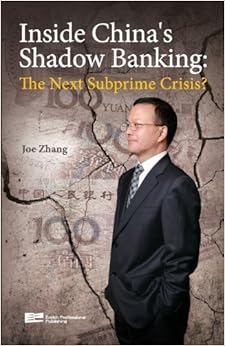 Inside
China's Shadow Banking: The Next
Subprime Crisis? By Joe Zhang, published by Enrich
Professional Publishing (Hawaii) in 2014. Inside
China's Shadow Banking: The Next
Subprime Crisis? By Joe Zhang, published by Enrich
Professional Publishing (Hawaii) in 2014.
The books starts as an autobiography of a banker who followed a somewhat unconventional career-path,
moving from a well paid investment banking position in Hong Kong to a micro-credit organization in China, before loosing
hope that micro-credit might actually do something substantial for the better of business in China. The book then offers wide
ranging reflections over the state of the Chinese financial sector,
pointing out risks but concluding that the situation is far from
hopeless.
The pivotal experience recounted in the this
book is Zhang's role as Chairman of a small Guangzhou based
micro-credit institution. He joined with the expectation that
the development of the micro-credit sector in China might be the
key to advancing small entrepreneurs and businesses similar to
the famous Grameen Bank in Bangladesh. However, he encountered
an an industry straight-jacketed by regulation, yet at the same
time subject to extensive bad practices: Whom you know often
counts for more than the quality of your business plans when it
comes to getting a loan. Zhang spares not with blunt comments
about what Indians might call the 'license raj', with
overlapping responsibilities of multiple regulators.
His wider reflections offer some insights
about the bubbles that many observers nowadays (2013) believe to
be present in the Chinese financial markets, including local
government loans and the housing market in at least some cities.
The government is actively intervening to prevent bubbles from
bursting, but interventions lead to flows of easy money
elsewhere. At the same time, the main (state-owned) banks sit
comfortably on attractive business models, getting savings at a
regulated low interest rates, and lending out to the lowest risk
customers. Higher risk customers, that's small business in
particular, find it difficult to get loans from the big banks,
while the sorts of organizations that do offer them loans
operate at the borderline of legality and charge immense fees.
Liberalization of the interest rate and easier entry for private
banks may address these issues, but are politically not en
vogue, yet.
Joe Zhang has also been
blogging on shadow banking.
|
|


The Good Women of China
and
Miss Chopsticks
by Xinran, translated by Esther Tyldesley, published in 2002 and
2007 by Random House.
The Good Women of China
and
Miss Chopsticks are
like yin and yang; neither is complete without the other, either
one alone would remain unbalanced. The
Good Women of China
is one of the most depressing books I have ever read; it gives
voice to women who could not talk about their lives in a
repressed society, until a late-night radio host listened,
recorded and collected their stories. Many lives were touched,
if not destroyed, by the cultural revolution and its side
effects. The short stories are true stories recorded by the
author during her work as a journalist.
Miss Chopsticks sets an optimistic tone for a
new generation of country girls who succeed in the city life.
Woven into the tale of three girls are subtle descriptions of
Nanjing and its people. Their story illustrates more than
scholarly work ever could how wide the gulf is between city and
country in China even today. Pictures and TV provide nice
images, yet only a book can convey the differences in hearts and
minds.
Also see
Xinran's
personal homepage, and
The Economist's
recommendation of her latest book "China
Witness" (2008) which is based on interviews with the older
generation of Chinese.
|
|
 Out of Mao's Shadow: The Struggle for the
Soul of a New China, by Philip P. Pan, published by Simon &
Schuster in
2008. Out of Mao's Shadow: The Struggle for the
Soul of a New China, by Philip P. Pan, published by Simon &
Schuster in
2008.
As Journalist for the Washington Post in
Beijing, Philip Pan recorded stories of people who stood up and
suffered under the Chinese communist party. Most of the stories
explore periods of Chinese history that are many Chinese still
feel uncomfortable discussing, or in fact know little about,
including the rightist movement and the Great Leap Forward in
the 1950s, the Cultural Revolution in the 1960s as well as the
events surrounding the Tian-An Men protests of 1989. A central
chapter introduces the life of Lin Zhao, a female Peking
University student who was imprisoned during the anti-rightist
movement in the 1950s and executed in 1965. Pan brings her live
alive through the eyes of Hu Jie, a passionate documentary film maker
who for five years collected information about her life, traced
down and interviewed people who had known her, and gradually
pieced together her
life, and personality, and eventually distributed his documentary
film through informal channels.
Pan's American-style journalism with
sensationalist terminology, and the weaving of interpretations
with reports of the people portrayed sometimes confused me
whether the book is telling the views of the journalist, or of
his interviewees. Yet, this stylistic concern not-withstanding,
this book brings to life the lives of people whose history
deserves not to be forgotten, even though telling it may still
be painful as many of the scares of the violence decades ago
have not healed yet. The author has a
website to
accompany the book. |

Zehn Jahre in Deutschland 1935-1945(留德十年), by
JI Xianlin(季羡林),
German translation published by Foreign Language Teaching and
Research Press and Georg August University Göttingen, 2009.
Personal memories are a rich source of insights; while we
know the broad flows of history from textbooks, it is often hard
to imagine how individuals experienced the times of political
turbulence. JI Xianlin was stuck in Germany for 10 years because
of the upheavals in his own country in the 1930s and 1940s, and
lived through the most difficult years of German history in Göttingen a
small university town. Several decades later, he took pen to paper to recall his
memories. By then, he had become the leading scholar in China
of old Indian languages such as Sanskrit, building on his
studies that he began in Germany in the 1930s. He came as an
idealistic young man planning to spend two years in Germany, but
as fate had it, he spend an entire decade.
What makes his memories so interesting to read are his astute
observations about people he met on his 10 year journey, and
communicating to his own countrymen first hand insights of
German culture - some of which still characterizes Germans
today, and some of which has faded away. People that left a lasting
impression, for better or worse, include rich-kid Chinese
students who were enjoying live in Berlin 1935 rather than
studying and, so he felt,
rather embarrassing his country; German professors in his specialized
subject who devoted their effort to his learning, his German
landlady who looked after him like after her own son, and
American solders of the liberating forces whose wasteful
lifestyle annoyed both him and his German friends.
Throughout these challenging years, he showed a humanity and
respect for people of all walks of life, and was received in
similar by many of the people he met. His engagement and
appreciation of people he knew little about when he set off
on the trans-Siberian railway, still serve as models for
students seeking studies abroad today.
|
|
Herr Huang in Deutschland: Ein Chinese Chinese auf Weltreise
zum Kulturerbe, by Huang Nubo,
German version published by
Georg Olms, Hildesheim, 2015.
German tourists have a bad reputation, especially
in Southern Europe, for always trying to evaluate everything,
for being rather direct with their critique - even if they may
be right - and for being somewhat insensitive to the feelings of
their hosts. After reading this book, I learned that there is
one group of people that is even worse than German tourists:
Chinese nouveaux riche! My Huang traveled first class to see the
UNESCO world heritage sites in Germany, and this book is his
diary: a blend of reminiscences his experiences, conversations
with people he met - including a fair number of local VIPs,
historical backgrounds of the heritage sites, and plenty of
grumbles about lousy service. The intended audiences is other
potential Chinese tourists (presumably those able to afford
first class), the German translation thus gives insights on how
one Chinese communicates to other Chinese, rather than to German
audiences.
The most interesting bits are the encounters
with people, be it ordinary people on the street or local
dignitaries, with whom he discusses a wide variety of topics,
and offers reflections on both contemporary Germany and
contemporary China. His historical introductions to the site are
accurate - he thanks his extensive support staff in the
acknowledgements - but primarily for Chinese audiences. His
critique of German service culture put his finger on some sour
points: especially when visiting small towns in Eastern Germany
service is slow, un-smiling, and often speak poor English. His
permanent repetition of this point, however, is annoying to say
the least. And some of his other generalizations from some poor
experiences are pretty offensive - especially on issues where
Germany is light-years ahead of China, such as road safety and
drivers actually respecting rules. In fact, in some passages I
doubted whether he actually lives in China, or in a nouveau rich
cocoon disconnected from the lives of ordinary Chinese. Just one
simple basic point about German culture: the rules apply to
everyone, people who ask for exception and not well liked;
people who demand exceptions will be met with the firmest
response. Sadly, even by the time of his return journey he
didn't learn that - he still tried to get a heavier bag checked
in than the safety rules permit.
The bottom line seems to be this: dictating
your experiences in a recording devise is a good way to get to a
first draft of a travel book. But from the first draft to the
final book is a process of hard work - cutting repetitions,
integrating themes, edit passages displaying your earlier
ignorance, and offering reflected opinions rather than the anger
of the moment. If you skip that hard work, it will show.
|
|
History
Reading about a country's history is always
worthwhile if you aim to understand its people, their
aspirations and their mental baggage. In China this is
particularly complex as many people are reluctant to talk about
the recent past (1950s to 1970s), and my students seem often
blissfully unaware of the grandparents life experience. On the
other hand, certain much earlier periods are glorified, yet
rarely critically reflected in China itself. Thus, Western
sources often provide more differentiated perspectives.
|
|
The Chinese Communist Party: A Century in Ten
Lives, edited by
Timothy Cheek, Klaus Muhlhahn and Hans van de Ven, published by
Cambridge University Press.

How to synthesize 100 years of complex history of China in a
readable book of realistic size? Timothy Cheek and his
co-editors have chosen to illuminate each decade of the history
of the Communist Party of China (CPC) through a bio biography of
an active participant in the party’s activities. What emerges is
not only a rich kaleidoscope of personal experiences, but an
illustration that throughout its history, debates over the
future path of the party have been commonplace and recurring,
and at time led to violent conflicts. While the party has
transformed from a small revolutionary group to long serving
ruling party, its policy priorities have shifted many times.
Thorughout the history of the party, the struggles of the party
have been not only a struggles to attain and retain power, but
also struggles for the 'right' path forward, and the
relationships with those people who lost an argument.
However, a persistent theme is the quest for a distinctly
Chinese approach to the big issues of the day – from revolution,
to economic catch-up, and to engaging in global trade and
politics. The multiple perspective approach to history of this
book contrasts refreshingly with the party’s own view of its
history, which is rather selective, and not exactly encouraging
historians to dig into sensitive topics. Readers will find it an
accessible lens to a complex story.
|
|
 Histoire
de Shanghai, by Marie-Claire Bergère, published by Librairie
Arthème Fayard in 2001 - English translation by Janet LLoyd "Shanghai:
China's Gateway to Modernity", published Standford
University Press, 2009.
Histoire
de Shanghai, by Marie-Claire Bergère, published by Librairie
Arthème Fayard in 2001 - English translation by Janet LLoyd "Shanghai:
China's Gateway to Modernity", published Standford
University Press, 2009.
Shanghai is a buzzing place
for business, culture and sometimes politics - yet in the long
history of China it is a relative newcomer. Before becoming a
'treaty port' in the treaty of Nanjing in 1842, it was a minor
city on a secondary river in the Yellow River delta. Yet with
the establishment of foreign the concessions (de facto
extra-territorial areas), Shanghai became a magnet for
adventurous minds, attracting business people and crooks,
military and paupers. Shanghai became a city of immigrants - not
just foreigners (who were a small minority, after all) but from
migrants from all parts of China, many retaining their distinct
languages and social networks over decades - and controlling
specific trade. Throughout the 19th century and up to the 1930s,
this dynamic mix of people has been the driving force of
economic modernization and social change, being far more outward
looking than the rest of China (and thus often see with distrust
by more traditional provinces).
All this economic dynamism,
multicultural interface and international trade came to a
crashing end with the Japanese occupation in the 1930s and
1940s. In the heyday of communist central control, Shanghai was
distrusted by the leaders and sidelines. Only in the 1990s did
Shanghai gain connect to its history as an outward looking,
business driven city.
Marie-Claire
Bergère traces the history from
the 1840s to the 1990s, uncovering details, diversity and
underlying trends that few Westerners (and probably many
Chinese) are not aware off. She gives due credit to the
diversity of groups, including the subtle differences between
the French Concession and the International (i.e. British &
American) Concession, as you would expect from a French author.
The book provides interesting background for those trying to
understand contemporary Shanghai - and China in general.
One quibble: the book cover of the
English version shows the contemporary Shanghai skyline with its
skyscrapers, yet the 'histoire' covered in the book does
not cover the period when they were build.
|
|

Shanghai Splendor: Economic Sentiments and
the Making of Modern China 1843-1949,
by Wen-Hsin Yeh, published by University of California Press,
2007.
Wen-hsin Yeh,
a history professor at University of California, Berkeley, takes
a more analytical and interpretative approach to explore the
evolution of Chinese society in Shanghai over 100 years. She
studies in great detail the social structures and their
evolution in the city, and in some exemplary companies such as
Bank of China. Changes in workplaces that come with 'modern' and
urban patterns of work affected all aspects of life, including
notably the shift from large families to urban 2 child families.
Yeh makes extensive use of local newspaper
archives, exploring especially the letters section, to elicit
insights on the changing social structures, and the personal
dilemmas that individuals in all parts of society faced. The
roaring 1930s brought great opportunities, high life, and the
import of Western products and ideas, but it was also a period
of hardship for many less fortunate. "Shanghai Splendor"
provides a rare glimpse into the lives of ordinary Chinese in
the early 20th century, before the Japanese invasion and later
the communist take-over changed the course of history.
|
|
 God's Chinese Son: The Taiping Heavenly
Kingdom of Hong Xiuquan, by Jonathan Spence, published by
Norton in 1996. God's Chinese Son: The Taiping Heavenly
Kingdom of Hong Xiuquan, by Jonathan Spence, published by
Norton in 1996.
Jonathan Spence had been recommended to me as the
most eminent scholar of Chinese history, telling history in a
most lively style. I was not disappointed, the book lived up to
these high expectations.
The story of the Taiping, a religiously
motivated uprising against the Qing emperors, is one of the most
horrific experiences of Chinese history. It started in the 1930s
with a poor man in the South of China having a dream that made
him believe that he was the son of god. His military force
conquered a major chunk of central China, mercilessly killing
its enemies, and set up imperial rule in Nanjing in 1853.
Endless military campaigns later, costing probably million
lives, the Taiping were annihilated by the Qing in 1864, and
quite literally killed off. The cruelty of this episode of
history falls nothing short of the worst periods of 20th century
world history.
Reading the account of the Taiping raises many
questions of human nature - how can such a thing happen?
What makes intelligent people follow religious zealots?
What does it tell us about the state of the Qing imperial rule
over China - regime that already had overstayed their welcome
but still survived til 1912. Being aware of such history also
helps understanding contemporary sentiments in society, even if
more recent history left further deep traces: With the
experience of the Taiping, it should be no surprise that Chinese
rulers are suspicious, or perhaps paranoid, of religious cults
in all forms.
|
 When China Ruled the Seas,
by Louise Levathes, published by Oxford University Press, in
1994. When China Ruled the Seas,
by Louise Levathes, published by Oxford University Press, in
1994.
By now, it is probably well known even in
Europe that Chinese merchants once traded across South East
Asia. Many will also have heard about
Zheng He, the
Chinese general who in the early 1400s led a fleet of Chinese
ships to sail not only to South East Asia, but to India and the
Arab peninsula. At least, when I show a map of those ancient
shipping routes in my introductory session of an international
business class, very few seem surprised.
Yet, how did China bundle its resources to
build such a massive fleet? And who was the man who let it,
Zheng He? This book provides the historical context for
these journey, and synthesis of (de facto) Chinese international
relations in the early Ming period. A few insights stood out for
me. Chinese traders have been the leading international traders
in East and South East Asia from about the 8th century B.C.
However, Chinese foreign policy experienced very strong swings
of a pendulum between strict isolationism and aggressive
globalization (to use 21st century terms). Under the third Ming
emperor, the pendulum swung for decisively towards
globalization: both in terms of enabling international trade and
establishing political relationships - even intervening in local
conflicts in other countries and installing a China-friendly
ruler. This policy implementation was led by
Zheng He who
supervised the building off ships four time longer and taller
than Columbus; Santa Maria, and himself undertook seven major
voyages, while other Chinese traders traveled as far as modern
day Kenya.
However, 'globalization' had its enemies even
then. What I didn't know is that Confucian scholars in
particular advocated a policy of focusing on China's home
territory: Part of being filial to ones parents is not to
venture to unsafe foreign places where return may be uncertain.
The end of China's external relations, and the weakening of its
fleet was thus mainly an outcome of internal politicking; in
addition the huge costs of building the fleet at the expense of
domestic project appear to have overstretched the economy.
Arguably the project was driven by a megalomaniac emperor, yet
it demonstrates the power of China when it is able to bundle its
resources to a singular objective.
|
|
 Mr
Selden's Map of China, by
Timothy
Brook, published by Profile Books, London. Mr
Selden's Map of China, by
Timothy
Brook, published by Profile Books, London.
Starting from a discovery of an old map in
Oxford University's famous Bodleian Library, Timothy Brook is
exploring the trade and geography of South East Asia in the
early 17th century. His story tells of a journey of discovery in
search of the meaning of the map - why it is so different from
contemporary maps made by either Chinese or European map makers?
The name by which the map is known, and which
gives the book its title, is, unfortunately, misleading.
First, "Mr Selden" was legal expert and scholar, about whom
Timothy Brook has a lot of anecdotes to tell - notably his
dispute with Dutch legal scholar Grotius that shaped
international law of the seas, a big issue now in the area
depicted in the map. However, Mr Selden's contribution to the
map is - for all that is known - that he is the last (and only
verified) owner of the map before it was bequeathed to the
library. We would expect historical maps to be named by the
person who commissioned it or the person who made it. In this
case these persons remain unknown, the historians best guess is
that it must be Chinese based either Fujian province of China,
or (Mr. Brook's hypothesis) in Bantam, which at the time was a
European trading post near modern day Jakarta.
The second curios matter is that it is not "of
China", but it is the sea-routes that connect Southern China to
key trading places in South-East Asia. China appears at the top
of the map, and looks distinctly odd to modern observers - but
apparently it is quite consistent with the depiction of China in
other maps of the time, apart from the fact that Chinese maps
always put China in the middle, and this maps doesn't. What
distinguished the map is, as Mr Brooks tells the story, that it
appears to have been drawn around the travel instructions used
by traders that travelled the seas, with the land then filled in
around the ports.
The area depicted is today subject to claims
and counter claims by the nations surrounding what the Chinese
call the South China Sea. Does the map give us answers as to who
has the older claims? No, it doesn't. The map is clear only in
advising seafarers to avoid large chunks of the sea - little
islands are a hazard to shipping, not land of interest to the
the mapmaker, nor, presumably to traders nor emperors of that
age.
Mr Brooks search for the story behind the map
takes the reader to the history of the late 16th and early 17th
century in both England and in South East Asia. An enjoyable
journey to meet many interesting characters, though a bit of
background knowledge of both British and Chinese history clearly
enhances the enjoyment. It also tells a lot of the
idiosyncrasies of Oxford scholars, past and present. The book
triggers curiosity - for starters here is the
website of the
Bodleian library.
|
 An
Irishman in China: Robert Hart,
Inspector of the Chinese Imperial Maritime Customs,
by ZHAO Changtian, translated by YANG Shuihui and YANG Yunqin,
published by Better Link Press, New York. An
Irishman in China: Robert Hart,
Inspector of the Chinese Imperial Maritime Customs,
by ZHAO Changtian, translated by YANG Shuihui and YANG Yunqin,
published by Better Link Press, New York.
As a young man, Robert Hart landed his first
job with the British foreign service of the day, and headed for
Ningbo, at the time a treaty port city with few European
residents. From there he moved on to serve the Chinese imperial
customs service, a role critical for the interface between
foreign traders and the Chinese authorities. He earned himself
respect among both the foreign traders and the Chinese imperial
court, which was rare those days. In his role, he became a
critical interface in some of the conflicts between the British
(or more generally, Europeans) with China throughout the 2nd
half of the 19th century.
This novel is written to honor his memory,
telling the story of his life in a vivid way and - as far as I
could see - largely following historical documents, but enriched
with the novelists descriptions. Along the way, the reader
learns at lot about the historical events of the time. For
Western readers the presentation of these events is also
interesting as they are described as today's Chinese recall them
- which sets different emphases than British textbooks do.
|
|
 A Thousand Pieces of Gold, by
Adeline Yen Mah,
published by Harper Collins in 2002. A Thousand Pieces of Gold, by
Adeline Yen Mah,
published by Harper Collins in 2002.
I had difficulties in classifying this book, and eventually
decided to place it in the history category. The author travels
through Chinese history and contemporary society using famous
proverbs as guide. Many Chinese proverbs synthesize a historical
event dating over two thousand years back. This book tells the
stories of these events and their historical context underlying
these proverbs, and explores how the wisdom embedded in the
proverbs influences the ways contemporary Chinese think and act,
including the author's personal experiences.
Adeline Yen Mah is better known for her autobiography 'Falling
Leaves' (as in the saying 'falling leaves return to their
roots'), which I have not yet read.
|
|

China: Eine Weltmacht kehrt zurück
(The Return of a World Power),
by Konrad Seitz, published by Berliner Taschenbuch Verlag in
2000.
China's history is long and complex, and
it influences modern China in ways subtle ways - both official
policies and individual mindsets. Yet, many accounts of Chinese
history are partial and, especially if written by local authors,
provide a particular ideological twist in interpreting events.
Thus, it is useful to read multiple accounts to form an opinion,
and to gain an understanding of the undercurrents in Chinese
society. The fist half of this 500-pages book provides a careful
review of China's history with an emphasis on the 20th century.
On this basis, the author then analyses the economic and
political reforms of the last three decades, and China's
prospects in the global economy.
(I am not aware of an English translation) |
|

Der Erwachte Drachen: Großmacht
China im 21. Jahrhundert (The Dragon has Awoken), by
Martin G.D. Chan, published by Theiss, 2008.
Chan outlines an insider's view
society and politics, and of China's its role in the world,
informed by eclectic study of China and personal involvement. His writing style often
includes sweeping statement and rarely does he provide concise
evidence for his assessments (there isn't even a bibliography),
thus inviting criticism on many of his specific assertions and
conclusions. Yet the
author is obviously knowledgeable on many aspects of
contemporary China and its recent history, and he outlines,
overall, a realistic image of where China stands in the world.
Moreover, he has the courage of outlining the role that he
expects China to play in the global economy by the middle of the
21st century as a strategic player in world politics. He predicts
that China will continue to raise, and a civil society will
emerge that offers a high degree of individual liberties yet not
democracy in the Western sense of the World. Yet he also
predicts major problems of an aging society and environmental
damage, and in consequence a role for China on the political
world stage that would be
constraint by domestic politics. This vision of the future of
China is highly uncertain as predictions always are, but it
provides a reasonable scenario for those wishing to engage with
China in the long term. (I am not aware of an English translation).
|
|
Fiction: Novels and Short Stories
I like to read novels and short stories as
complement to more factual sources of information because they
can convey much better than an academic study could the
atmosphere, and the feeling, anxieties and beliefs of
individuals. Some of the books in this section helped me a lot
to understand how Chinese people might think and feel about
their life.
|
|
 A
Loyal Character Dancer, by Xiaolang Qiu, published
by Hodder in 2002 A
Loyal Character Dancer, by Xiaolang Qiu, published
by Hodder in 2002
A crime novel set in Shanghai in the early
1990s. In some ways, Inspector Chen resembles famous
characters of British crime novels like Inspector Morse or
Hercule Poirot. Yet, solving a crime in China is not as
straight forward as in Britain as forces unknown are lurking
in the background, some political, some criminal.
In this story, Inspector Chen is joined by
a female U.S. officer searching for a missing women whom she
is to take to the US to help a crime investigation there.
Jointly, the exchange poetry, plenty of rich food, with a
bit of romance is hanging in the air. Qiu manages to subtly
integrate descriptions of life in Shanghai in the story,
which provides not only with a gripping crime novel, but a
vivid introduction to the multifaceted life in Shanghai in
the early 1990s - a time so recent but already history.
|
|

The Uninvited,
by Geling Yan, published by Faber in 2007.
Set in Beijing at the turn of the
millennium, this novel shows China from the perspective of
someone who did part-take in the rapid economic boom and
tries to enter through a backdoor: Pretending to be a
journalist, he joins banquets where the
nouveaux riche aim to impress journalists and
other mortals. Yet in this bright new world, he also
encounters the trappings of a society with rapidly changing
its rules, and sometimes with apparently no rules at all.
Others left behind see him as a means to publicize their
plight, and thus he travels through various undercurrents of
Beijing's diversity society. The novel exposes failings of
modern Chinese society, with the novelist's liberty to
exaggerate, it may be a bit scary for those not yet familiar
with China. It does however introduce readers to the riches
of Chinese cuisine, which may delight some and disturb
others.
|
Distant Star, by Barbara Bickmore, published by
Ballentine Books in 1993. (I read the German version "Ein
Ferner Stern in China" published by Knaur).
This is a novel, that
provides rich inside into the
complex of modern Chinese history that is hard to understand for outsiders, or even for
Chinese themselves. This novel takes the reader on a tour of
China that starts in the Shanghai of the 1920s when the
fictitious heroine lands as wife of a journalist. She lives in
China for the next decades, encounters ordinary people and
writes about her daily life. The novel shows how life in China
used to be, and how it has changed under the pressure of
historical events. The heroine becomes friends with Madame Sun,
wife of Sun Yat-Sen, and interviews many other personalities of
historical importance. These encounters happen only in the
authors imagination, but they paint a vivid picture of China at
the time, describing the atmosphere during the historical
events. I thoroughly enjoyed this book, though the last chapter
can be skipped without loss.
|
|
 The Bridegroom, by Ha Jin, published by Vintage
International, New York in 2000. The Bridegroom, by Ha Jin, published by Vintage
International, New York in 2000.
This collection of short stories provides lively insights in
the lives of ordinary Chinese people in the early years of
economic reform. These stories provide fascinating insights in
the complex webs of relationships in private life and the work
place, embedded in Chinese culture and the pervasive influence
of the communist party. My favorite story is "After Cowboy
Chicken Came to Town", which tells the fast food revolution in
provincial China from the perspective of an ordinary worker
struggling to believe their luck of earning more than his
accomplished father, yet unable to understand how the business
works, and why they do what they do. While scholars explore the
cultural shock experienced by Western expatriates in China, this
vivid story illuminates the culture shock of facing an
expatriate in your own company.
|
|
|
|

